
Active Mom Insights
Blog posts by Ashley Reid
Post Baby Bounce Back: When to Start Thinking About Weight Loss
Snap Back, Bounce Back, Body Back...all terms you hear when it comes to moms that have dropped baby weight rapidly after giving birth (all terms that I think are inappropriate). Celebrities seem to do this rather well. So the question becomes, when is it appropriate to start thinking about weight loss after giving birth? My answer is two fold, but I will try to keep it simple.
Snap Back, Bounce Back, Body Back...all terms you hear when it comes to moms that have dropped baby weight rapidly after giving birth (all terms that I think are inappropriate, but that’s for another post). Celebrities seem to do this rather well. So the question becomes, when is it appropriate to start thinking about weight loss after giving birth? My answer is two fold, but I will try to keep it simple.
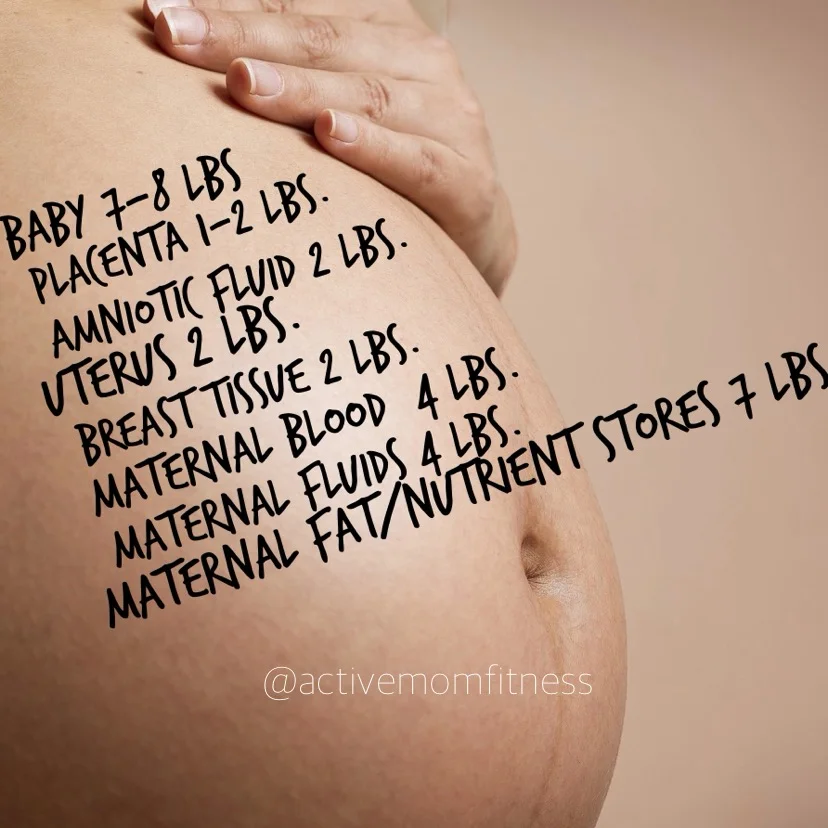
If you begin your pregnancy at a healthy weight, the guidelines state 25-35 pounds of weight gain is recommended. Some women gain more and some less. The goal during pregnancy, as it should be at all times during your life, is to maintain a healthy weight that’s appropriate for you. Weight gain is healthy during pregnancy, but excessive weight gain is not. Excessive weight gain can make it harder for you to lose weight after pregnancy. The point I want to drive home here, is that your first consideration of postpartum weight loss should be while you’re pregnant. Your goal should be to make good food choices, be physically active and consider other lifestyle factors that promote healthy weight gain during pregnancy.
For many of you reading this, you’re beyond pregnancy and probably want to know when to start thinking about weight loss after having baby. You’ll notice that immediately after giving birth your numbers on the scale will drop (losing fluid, weight of baby, etc.). So when should you start thinking about the rest?
I’ll preface it by making it clear that I feel your priority is adjusting to life as a mom and taking care of baby. But, there are many moms that feel the pressure from our “snapback” society or from the expectations you have for yourself to get back into your pre-pregnancy jeans. Some of you may physically feel uncomfortable hanging on to the extra weight. Beth Auguste, RD of Be Well With Beth agrees, “we hear so much about snapping back that it makes sense if you want to prioritize weight loss, but it not what your body needs. Now is the time to remind yourself that your body needs nutrients to heal, especially if you are breastfeeding”. Although it may not a priority, it is on the minds of a lot of moms so discussing weight loss is relevant. Here is my guide to help you determine if you’re ready to start making an effort toward weight loss:

Are you incorporating healthy habits? Maintaining a healthy weight is a lifestyle. Your weight loss efforts will be difficult if you haven’t found a way to incorporate healthy habits into your new life as a mom. Examples include: not skipping meals, drinking enough water, finding time to move, etc.
Are you recovered? It can take your body up to 12 months to recover after having a baby and this should be priority. Consider: whether your c-section scar has healed, how are you feeling emotionally? Is your core getting stronger? Are you finding time to sleep? Registered dietician, Jennifer Weis, shares, “there are other concerns during this time such as healing any birth wounds, ensuring a nutrient dense diet and keeping mom well-fed to be able to handle the stresses of taking care of a new baby while sleep deprived”.
Is exercise a stressor? Weight loss efforts are best when you combine exercise and nutrition. However, structured workouts shouldn’t be a priority if finding time for them causes you stress (stress hormones make it hard to lose weight), or if you’re severely sleep deprived and won’t be able to recover, or if exercise makes you feel physically worse.
So if you’re postpartum and can say your habits are healthy, you’re recovered and structured exercise seems realistic, then yes, it may be appropriate for you to up your weight loss efforts. This timeline will be different for every mom. Weight loss progress will be different for every mom (consider factors such as whether hormones are still affected by breastfeeding, your age, the volume of exercise, nutrition habits, weight loss history, genetics, etc.). If you need some guidance on this process, don't hesitate to reach out to me..
As always, these posts are inspired by moms like you. If you find them interesting, please share on social media.

2018 Reflections
I’m a planner and organizer, so I always look forward to the New Year as a chance to set new goals and create a plan to accomplish them. However, more recently I realized that I’ve been missing a step... I don’t properly take time to reflect on the year that is coming to a close. I have been depriving myself from celebrating accomplishments and acknowledging where I fell short. So before we storm into 2019 with new goals and hopes, take some time with me to reflect on 2018. Inspired by several different reflection resources online, I’ve compiled this one for you.

I’m a planner and organizer, so I always look forward to the New Year as a chance to set new goals and create a plan to accomplish them. However, more recently I realized that I’ve been missing a step... I don’t properly take time to reflect on the year that is coming to a close. I have been depriving myself from celebrating accomplishments and acknowledging where I fell short. So before we storm into 2019 with new goals and hopes, take some time with me to reflect on 2018. Inspired by several different reflection resources online, I’ve compiled this one for you below.
I will provide a goal setting guide as we enter into the New Year. Expect it the first week of January.

2018 Reflection Questions
1. What I know about myself today that I didn’t know a year ago…
2. This year I dedicated too much time to…
3. This year I didn’t spend enough time…
4. The most valuable relationships to me this year were…
5. I improved my wellness in the following ways…
6. _________ brought me happiness this year.
7. _______ stressed me out this year.
8. I overcame the following obstacle...with the following skill or superpower…
9. I said I was going to ______ this year, and I did.
10. I said I was going to ______ this year, and I didn’t.
I hope you enjoyed the reflection. Let’s take these achievements and lessons learned and take on 2019! If you’re ready to get a jump on your fitness resolutions, check out my January specials.

Getting to the Core of Pregnancy
The body’s “core” is a system of muscles that support the spine and pelvis, with the ceiling being the diaphragm and the bottom of the cylinder being the muscles of the pelvic floor. The shift of the pelvis and the separation of abdominal muscles during pregnancy can result in a weaker core and unstable pelvis. This may lead to pain in the lower back and pelvis during pregnancy.
Three ways beyond exercise to promote a healthy core during pregnancy.
The body’s “core” is a system of muscles that support the spine and pelvis, with the ceiling being the diaphragm and the bottom of the cylinder being the muscles of the pelvic floor. The shift of the pelvis and the separation of abdominal muscles during pregnancy can result in weakness and instability. This may lead to pain in the lower back and pelvis during pregnancy. Women without any contraindications are advised to counteract the instability and weakness by strengthening abdominal, back, butt and pelvic floor muscles through exercise
However, beyond exercise, pregnant women shouldn’t overlook these 3 strategies to encourage a healthy pregnant core.

Image from http://www.fitnessnetwork.com.au/resources-library/aqua-pelvic-floor
Tip 1 for a healthy pregnant core: perform diaphragmatic (belly) breathing
Why? The diaphragm is a thin muscles that separates the chest from the abdomen, forming the roof of the core. A 2013 article in The Journal of Multidisciplinary Healthcare discusses the functional relationship between the diaphragm and the pelvic floor, indicating the diaphragm has a role in core function and pelvic stability. The diaphragm and pelvic floor muscles should work together, meaning as the diaphragm contracts and moves down during an inhale, the pelvic floor muscles should relax and lower. The opposite is true on an exhale, with the diaphragm relaxing and rising while the pelvic floor is contracting and rising

From https://bebrainfit.com/breathing-exercises-anxiety/
How to perform diaphragmatic breathing: Women should lie on their back with knees bent or for pregnant women beyond 16 weeks, sitting is appropriate. Inhale slowly to the count of 3, letting your belly expand outward. Exhale slowly to the count of 3, allowing your belly to relax. Repeat this 5 times. As the belly grows this will become more difficult and “chest breathing” will become more natural, however women can still be deliberate about the mind body connection between the diaphragm and pelvic floor. This type of breathing may also be useful in the first stages of labor as a relaxation technique and is a safe postpartum exercise to begin rebuilding the core after baby.
Tip 2 for a healthy pregnant core: Rise up with a side roll
Why? There are three groups of muscles that make up the abdomen. During pregnancy the rectus abdominis group (6-pack muscles), can separate due to increased hormones and tension placed on the abdominal walls due to the growing baby. A study by Sperstad JB, Tennfjord MK, Hilde G, et al. 2016; found that approximately 33% of women at 21 weeks pregnant will experience separation and that number rises to 60% when looking at women 6 weeks postpartum.This separation is called Diastasis Recti Abdominis. Anything that increases the pressure within the abdominal wall can widen the separation of the muscle (sneezing and coughing included). One factor that women can control is the pressure exerted on the abdominal wall while rising up from a lying position.
How to create less pressure while rising: Women can rise up to sitting or standing by performing a side roll, rather than coming straight up and putting excessive pressure on the abdominal walls. From lying on the back, first bring knees to a bent position then roll to the side. Using both arms, push the body up. If lying in a bed, then drop both legs over the bed and stand. If coming up off of the floor, push up on both arms and then come into a kneeling position to rise and stand.

From http://brochures.mater.org.au/brochures/mater-mothers-hospital/pregnancy—information-for-women-and-families
Tip 3 for a healthy pregnant core: Avoid bearing down or breath holding
Why? As already discussed, increased abdominal wall pressure can lead to further separation of the abdominal muscles.
How to avoid bearing down or breath holding: women should exhale through any strenuous movements that might cause her to bear down or hold her breath. This might include bowel movements, lifting objects or other children, and movements during exercise.
Although these 3 strategies work to improve core function and decrease abdominal wall pressure, more research needs to be done on the risks and preventative factors related to pelvic and back pain, as well as abdominal separation during pregnancy.
Ready to learn more? Download 5 Tips for a Stronger Core During Pregnancy.
The FITT Principle: Design a Workout That Gets Results
How Do You Design a Workout Plan Using the FITT Principle?
Update 4/2026
Personal trainers use a framework called the FITT Principle to design exercise programs for their clients. Now it’s time for you to take charge of your workout plan. If you have already set a specific fitness goal and have a sense of your current fitness level, you can use this formula to design a workout plan that leads to results.
What Is the FITT Principle?
FITT stands for frequency, intensity, time, and type. These four variables work together in an effective plan. If you’re pregnant, I like to add a third T, which stands for Trimester. I go into this in my book, Active Mom.
Frequency is how often you exercise. Intensity is how hard you work. Time is how long each session lasts. Type is the kind of exercise you're doing, such as running, cycling, strength training, or swimming.
The first thing to understand is that these variables are interdependent. The intensity will affect how long each session is, and the type may impact frequency. Without having a degree in exercise science, understanding that one change can impact another variable is the first step in creating and sustaining your fitness plan. Because frequency, intensity, time, and type are connected, changing one means you should consider whether you need to manipulate the others. If you increase the intensity of your workouts and don’t adapt frequency to allow for recovery, you may not get the results you’re hoping for.
How to Use FITT to Build Your Plan
Let's look at a practical example. A healthy mom of two who can barely find time to workout, but enjoys exercising outside, wants to meet general health guidelines. Because the number of days she can find time to work out is her limiting factor, she decides to start with the frequency variable. She can realistically commit to 2-3 days per week. On one of the days, her kids stay later at school, so she decides she can fit in one 45-minute workout on that day, but the other 1-2 days will have to be 30 minutes. Now she has frequency and time determined. She’s a fairly experienced exerciser with no injuries or limitations, so when she chooses intensity, she decides that for the shorter workouts, she will exercise at higher intensities and on the longer day, she’ll do something more moderate like brisk walking or a bike ride.
This is how to manipulate variables to meet your goals and make your workout fit your lifestyle. For some of you, your starting factor might be intensity. If you’re avoiding high-intensity exercise, your type and frequency should correspond.
As a disclaimer, it’s not always that simple, and plenty of other barriers or considerations may exist for you, especially during and after pregnancy, but as I said, it’s a foundational starting point and worth considering.
Let’s take a look at the guidelines so that you understand what is recommended, and you can use the FITT(T, for Trimester) principle to personalize your plan. As a side note, if you need more guidance than this article, the Active Mom book is a comprehensive guide to help you personalize exercise and understand your needs so you can stay active through all stages of motherhood.
ACSM Aerobic Exercise Guidelines
The following are general aerobic exercise guidelines for most adults based on current ACSM recommendations. Use these as a starting point, not a prescription. Your specific goal, fitness level, stage of motherhood, and schedule will determine where within these ranges makes sense for you.
Frequency: 3 to 5 days per week
Intensity: Moderate to vigorous. Moderate intensity means you can talk but not sing during the activity. Vigorous intensity means you can only say a few words before needing to catch your breath.
Time: 150 to 300 minutes of moderate intensity activity per week, or 75 to 150 minutes of vigorous intensity activity per week. These can be accumulated in single sessions or broken into shorter segments of at least 10 minutes.
Type: Any sustained, rhythmic activity that elevates your heart rate. Walking, cycling, swimming, dancing, running, and rowing all qualify. Choose something you will actually do consistently.
Don't Forget Resistance Training
Aerobic exercise is only part of the picture. A complete plan includes resistance training, and the FITT principle applies here, too. Current ACSM guidelines, updated in 2026, recommend training all major muscle groups at least twice a week. Consistency and effort matter more than complexity. Whether you are using barbells, resistance bands, or bodyweight, choose an approach that fits your life and build from there.