
Active Mom Insights
Blog posts by Ashley Reid
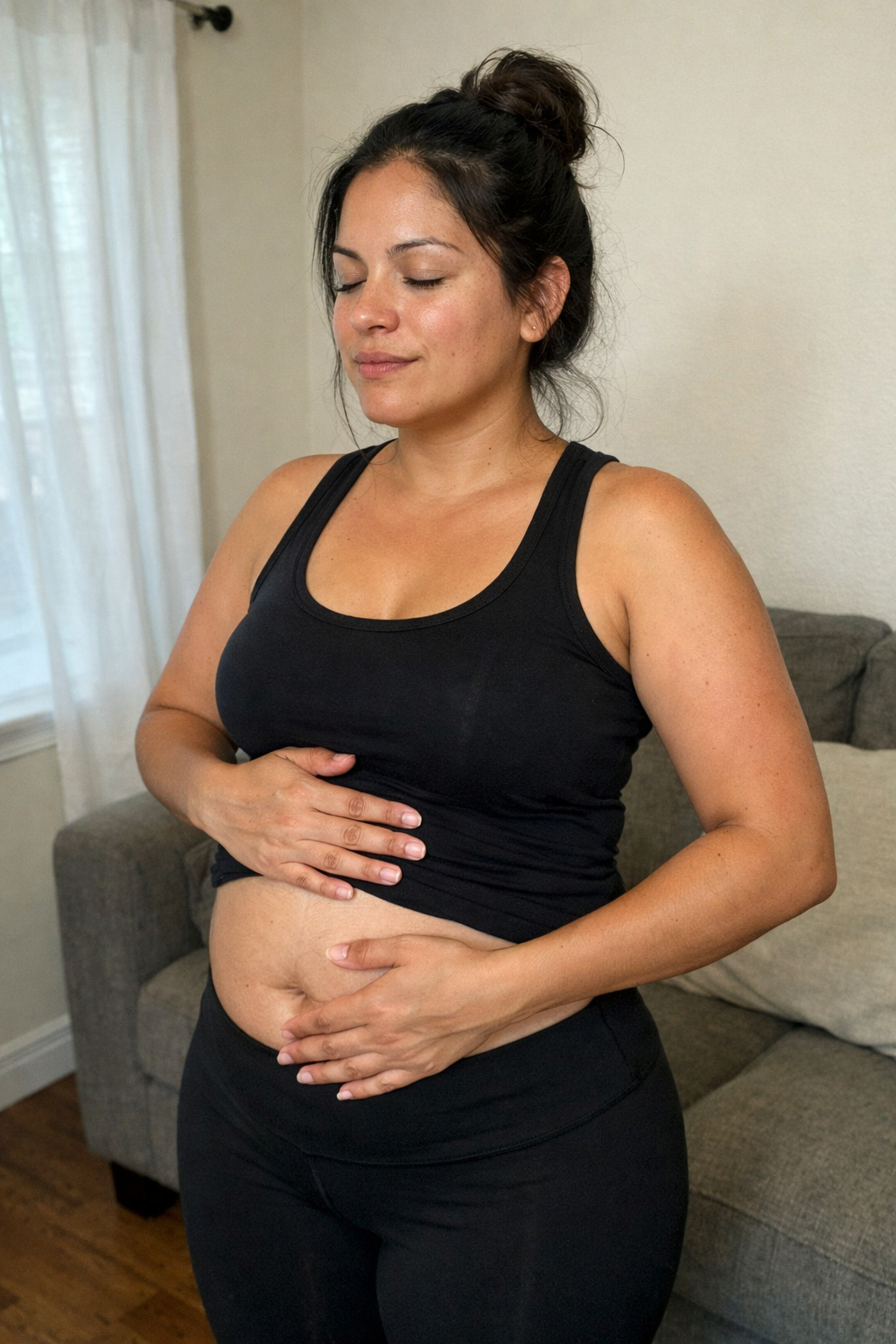
How Do You Strengthen Your Core Postpartum?
The best way to strengthen your core postpartum is to take a progressive, personalized approach to postpartum core training, ensuring you’re not overloading the healing tissues and gradually building strength, while also addressing concerns like diastasis recti or pelvic floor issues.
After having a baby, your abs might feel like mush, and moms are often shocked at how weak they feel, especially if you’ve exercised during pregnancy. This is common, but the good news is that if you allow time for healing, address any functional concerns, and follow a step-by-step core training progression, your core could become stronger than it was before pregnancy.
In this article, we’ll explore the foundational elements of postpartum core training, such as how long it takes and where to begin.
Start with the Deep Core
No matter what you did before or during pregnancy, all moms will benefit from reconnecting with their deep core by coordinating breathing with muscle contraction. This initial step involves the diaphragm and transverse abdominis. If you think of your core as a cylinder or canister, the diaphragm (your breathing muscle) is the ceiling. During pregnancy, the diaphragm often shifts upward due to your growing belly, which can alter your breathing. Most moms know the diaphragm is connected to your respiratory system, but may not realize that it should move in coordination with your deepest core muscle, the transverse abdominis. During postpartum core training, you can use breathing to help activate your transverse abdominis and improve core function by coordinating your breathing with your movements.
Your transverse abdominis acts like a corset wrapping around your trunk, and will provide the stability you need to carry, rock, hold, and lift your new baby. This function of your core is essential to reduce your risk of back pain, address any pelvic floor conditions, and lay the foundation for future fitness goals.
How Do You Activate Your Transverse Abdominis?
Coordinating the movement of your diaphragm with your abdominal muscles may take practice. Eventually, the synergy between breathing and muscle activation should become a habit that you don’t have to think too much about, and you’ll instinctively exhale on exertion (during lifts, picking up something heavy, etc.). However, as you’re rebuilding core strength after having a baby (even if it’s years postpartum and you’re just returning to exercise), you’ll want to focus on your belly expanding as you inhale. When you breathe out, this is when you can gently engage the transverse abdominis, drawing it in toward your spine. Note that your belly should visually move in as you exhale; don’t make the mistake of sucking your belly in as you’re sucking in air. After working with hundreds of moms, I’ve realized this may seem simple, but it can take weeks to get it right. But trust me, this is an important first step.
Do you have to wait until you’re cleared for exercise at your six-week postpartum appointment? Nope. In fact, the 2025 postpartum exercise guidelines suggest starting movement earlier than that if you’re up to it. For some moms, you’ll be able to start breath work during the first few days after giving birth.
Here is one way to practice:
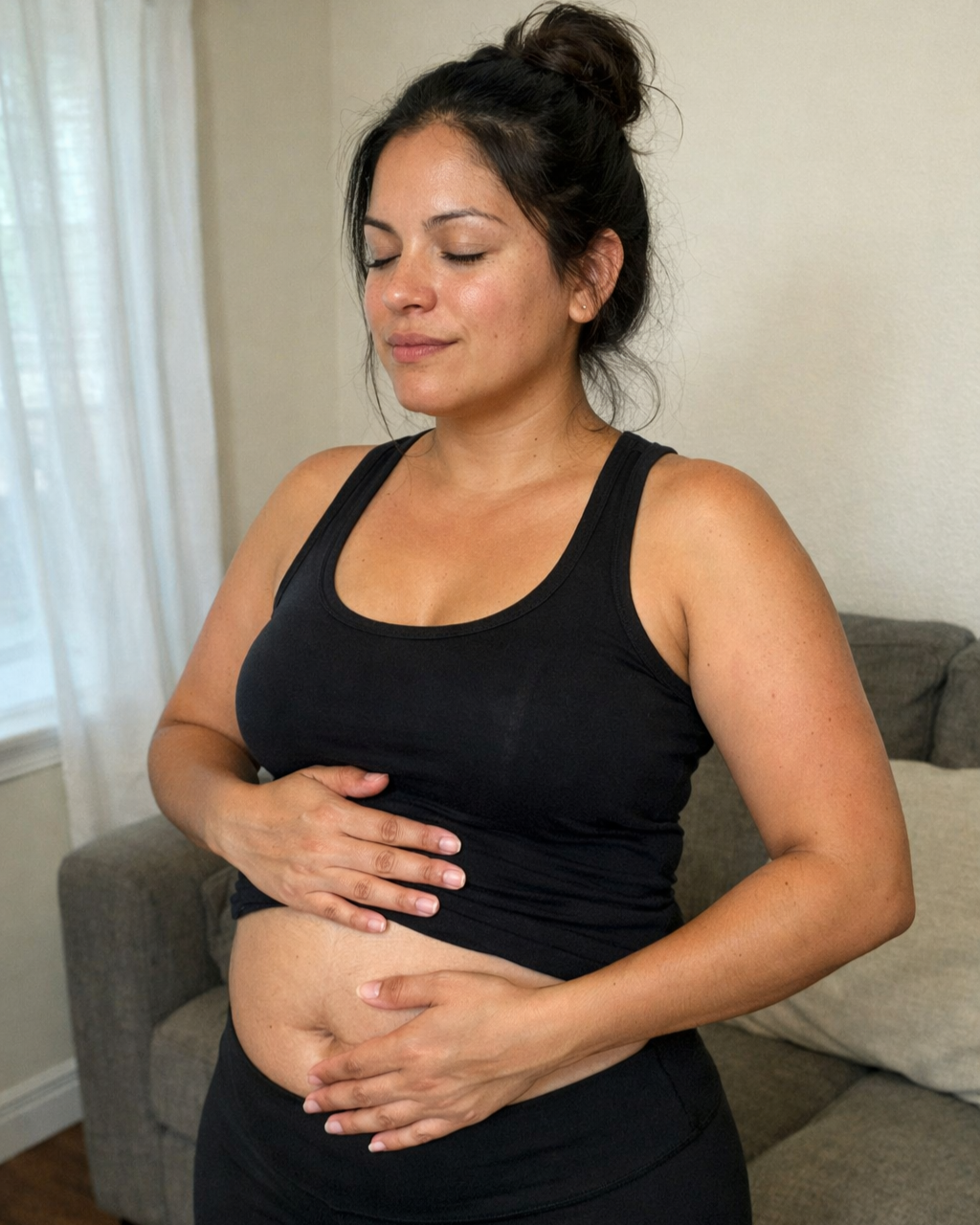
Breathe with Hands on Your Abdomen: Either standing or lying on your back, place your hands on your lower abdomen, with your finger tips on each hand facing each other, and the tips just touching but not interlacing. As you inhale, notice your finger tips separate further from each other. As you breathe out, notice your finger tips touch, or perhaps overlap with stronger contractions of your transverse abdominis. Slowly take breaths in and out, making sure that your chest isn’t heaving upward on your inhales.
How Long Does it Take to Strengthen Your Core Postpartum?
A 2021 study found that both the thickness and the ability of your deep core muscle to contract are impacted postpartum. The study showed that there was some increase in muscle thickness after 1 month, but that it could take more than six months to recover after delivery. Additionally, it took at least four months for contractile function to improve.
What does this mean for you?
You might not feel activation or very strong contractions during the fourth trimester, but as long as you keep at it, you’ll make progress and start to feel stronger.
Before training other muscles like your obliques with twisting movements or your “six pack abs” with sit-ups, ensure you’ve established foundational strength in your transverse abdominis.
Give yourself some grace. Your body physiologically needs time. Be consistent and be patient.
Don’t assume you’re too advanced for these basics. Pregnancy leads to real changes in these muscles, and all moms need to re-establish strength and function in their deep core, starting with coordinating breath and activation.
Wrapping it Up
This article was meant to give you a brief introduction to postpartum core training, and help you understand it’s normal for you to feel disconnected from your abs, because the strength and thickness take time. Hopefully, you also have a clear understanding that breath work to activate the transverse abdominis is your first step.
When you’re ready to move beyond the first step, or if you need more guidance on getting started, consider the Core Foundation video course or the comprehensive guide to exercise during motherhood, Active Mom.

Have You Been Cleared for Exercise?
If you’re currently pregnant and have been consistent with exercise, you’re probably already planning your return to exercise postpartum, especially if exercise has always been a part of your life. I know most of my clients who have continued to stay active during pregnancy have goals to return to fitness as soon as their doctor gives the OK postpartum.
If you’ve recently had a baby, you may be awaiting your postpartum appointment to find out if you are “cleared for exercise”. Getting cleared for exercise can feel liberating if you’ve been missing that sense of control over your body. However, it’s important to understand what being cleared means as well as how to return to physical activity after pregnancy.
What Does "Cleared for Exercise" Mean?
Being cleared for exercise is your doctor’s medical opinion that you are physically ready to start increasing physical activity, or that it’s generally safe for you to exercise. This typically happens at your 6-week postpartum check-up, but if you’ve had complications like tearing or are recovering from a c-section, that may happen a bit later.
In other words, your doctor will either tell you it’s safe, or that it’s not. Which, don’t get me wrong is important information. You shouldn’t begin to increase physical activity or exercise if you have contraindications. However, the trouble with the yay or nay approach is that it’s one size fits all. Postpartum exercise clearance usually comes with the advice that you should ease back into it and listen to your body. This is not inherently bad advice, but it’s pretty subjective and doesn’t educate you on what a proper progression looks like, or why easing back into it is essential. Fortunately for you, if you’re reading this, you probably already have an understanding that there are important considerations when returning to exercise after having a baby. In the rest of this article, I’ll provide you with tips and strategies to guide you in your return to fitness.
What do the postpartum exercise guidelines say?
At the time of this article (12/2023), postpartum exercise guidelines have not been published. BUT, there is encouraging news that they’re finally in the works and should be released soon. I’ll link to them when they come out, but in the meantime, I’m going to provide you with some tips inferred from the research that exists, my background in exercise science, as well as the practical experience I have working with pregnant and postpartum moms.
Do you need to see a pelvic floor physical therapist or postpartum exercise specialist?
The ideal answer is yes, it would be great if everyone was able to receive personal guidance from a professional after having a baby. The more realistic answer for most people is that it depends. If you have any concerning symptoms like incontinence, pelvic or back pain, abdominal separation, or others then I strongly encourage you to see a pelvic floor physical therapist as a starting point. If you live in a major city there are probably those that accept insurance, as well as cash-based, but you should be able to see someone. Additionally, if you are concerned about excessive fatigue, anxiety, or depression, I’d also recommend seeing a professional before beginning a structured exercise program beyond general physical activity. If you were not active during pregnancy or you’re new to strength training or core exercises, a postpartum exercise specialist can save you a lot of time and energy in the long run by helping you determine which exercises are best for you.
Time for the Tips
Aerobic
The general physical activity guidelines for adults recommend 150 minutes per week of moderate or moderate-vigorous physical activity, with activity occurring on most days. The postpartum guidelines may skew a bit, but will not be drastically different. In any case, that duration and intensity is what you’re working up to and not where you’re starting. For most moms that I’ve worked with, getting out and pushing the baby in the stroller for 10-20 minutes every day is a great starting point. Walking is great because you can still spend time with your baby, being outside may boost your mental health, it’s a low-impact activity ensuring you’re not stressing your healing pelvic floor too soon, and it’s a trackable activity that you can strategically progress to longer durations, distances, and intensities.
Strength
Here’s where I plug the method I developed called the Core, Function & Fitness approach. The idea is that the core is the foundation of fitness and where you should prioritize your efforts. During the postpartum period, this most often means addressing any pelvic floor concerns and coordinating breath with your deep ab muscle activation. Initially, this could be through pelvic tilts or heel slides but can progress to exercises like the deadbug. After you’ve made some progress in core strength and function, you can add in functional strength training. So this might mean you’re spending 5-10 minutes on isolated core exercises and then doing a full body circuit focusing on muscles you need to move through your day pain-free, as well as the major movement patterns. For example, lengthening chest muscles and strengthening upper back muscles is usually a necessary focus for moms due to the feeding posture.
After you’ve laid a solid foundation of core training and strength training you can continue to increase the duration, frequency, and intensity of your workouts, while also setting more specific goals like running.
Don’t Forget About Lifestyle Factors
To benefit from exercise, there are more factors than the workout or activity. Things like sleep, nutrition, hormones, childcare, the ability to be consistent, and the ability to recover all determine whether you’ll get the benefits you’re expecting from exercise. For this reason, not jumping back into structured workouts until you are more healed, getting a bit more sleep, and have found ways to stay hydrated and eat a balanced meal is a reasonable decision and it’s smart. Now this doesn’t mean you should do anything. You should begin to increase physical activity and address core strength at a minimum, but it means that rather than aiming for pre-pregnancy 60-minute workouts at the gym, your starting point might be daily walks and two minutes of isolated core work when the baby is doing tummy time.
On the flip side, if you have childcare help, you’re feeling healed and sleep deprivation isn’t an issue, you may be feeling like you’re ready to get back to your old routine. To that I’ll say, remember that your abdominal and pelvic floor muscles and tissues are still healing and your hormones are still fluctuating, so even if you’re feeling good, I’d suggest the same gradual core, function then fitness framework. You may move through the progression quicker than someone else but don’t skip the gradual transition.
The Takeaway
This article is just one piece of the postpartum exercise puzzle, but I hope it gave you some perspective on getting cleared for exercise. To summarize:
Prioritize healing
Remember that lifestyle factors should support the type of workouts you’re doing
Core, then add functional strength then set fitness goals
Being an active mom is a lifestyle and will look different as you move through different stages of motherhood. The fourth trimester is not even the first chapter, we’ll call it the introduction.
Ready for more tips? Download 5 Tips for a Stronger Core After Pregnancy.