
Active Mom Insights: Pregnancy and Postpartum Exercise Blog
Research-based answers to the questions moms ask most about exercise during pregnancy, postpartum, and beyond. Written by Ashley Reid, exercise physiologist and author of Active Mom.

Apply Four Blue Zone Secrets to Motherhood
For moms, living a long healthy life means seeing our kids grow up and witnessing who they become. In areas called Blue Zones, certain lifestyle habits help residents live to 90, 100, or beyond. Genetics plays a role, but researchers have found it’s our daily behaviors and environment that play a bigger role. So what can moms learn from the Blue Zones in order to live a long happy and healthy life with our children?
For moms, living a long healthy life means seeing our kids grow up and witnessing who they become. In areas called Blue Zones, certain lifestyle habits help residents live to 90, 100, or beyond. Genetics plays a role, but researchers have found it’s our daily behaviors and environment that play a bigger role. So what can moms learn from the Blue Zones in order to live a long happy and healthy life with our children?

Plant-based Isn’t a Fad
In Blue Zones people are eating minimally processed, plant-based foods like fruits, beans, vegetables, and whole grains. Note, that these are not the processed plant-based foods you find in the freezer section. Although Most Blue Zone residents aren’t vegetarians; they just eat meat less often and in smaller portions so plant foods dominate their diet.
Tips to add more plant-based foods:
Eat more plant proteins like chickpeas and lentils
Try “meatless” Mondays
Consider meat a side rather than the main portion of the dish
Make it a challenge to introduce your child to a new plant food each week
Move More
Blue Zone residents are physically active throughout daily life. They avoid long sedentary periods and can be seen gardening, or doing tai chi. In one study in the British Journal of Sports Medicine they found that for each additional 30 minutes of sedentary time on a typical day, men were 17% more likely to die during the five-year study. However, each 30 minutes of light activity reduced the odds of death by 17%. So for moms that have a hard time fitting in workouts, your daily physical activity is just as important, if not more. You can still have an extremely positive impact on your well-being without hitting the gym.
Tips for moms:
Working from home? Aim to get up between meetings to stretch or take one walking meeting each day
Get the guidance you need to stay active during pregnancy and return to exercise after having a baby.
Rather than sitting on the park bench, chase your child or push them on the swing
Distribute chores throughout your day versus all at once
Make family time active with weekend activities like hikes or biking
Eat Mindfully
People living in the Blue Zones focus not just on what they eat, but how they eat. There isn’t mindless munching on an entire bag of chips while watching TV, instead, they’re putting their fork down between bites and are intentional about how they’re eating, usually stopping when they are 80% full. Residents experience more joy from their food and tend to practice better portion control through mindful eating.
Tips for moms:
No screens during meals
Make time for meals so that you’re not rushing
Stop before you’re full
Substitute the Facebook Groups for Real groups
Close community ties help Blue Zone residents stay active and happy. Loneliness, stress, and depression can cause physical health problems. The saying, “It takes a village” isn’t just about the support we need to raise our kids. As a mom, you also need connection and support for yourself and can learn from the benefits of those living in the Blue Zones.
Tips for moms:
Arrange playdates for your kids with parents that you enjoy spending time with so that you can benefit too
Join a prenatal or postpartum fitness, or wellness group
Find a neighborhood mom to go on walks with
Limit social media scrolling and call a friend for a quick chat instead
So although we can’t all live in the Blue Zones, we can take a different approach to what it means to lead a healthy lifestyle. As we’re modeling a healthy lifestyle for our family, we can’t forget about the daily habits that have a profound impact on our lifespan and quality of life. Let’s all try to sit a little less, slow down at mealtime, connect with our village, and consider what’s on our plates.

11 Ways to Keep Your School Age Child Active
It is challenging when your child is really young to find and make time to workout, especially at home and without interruption. I always tell new moms that all of the effort they put in early to prioritize exercise will pay off as their child gets older. However, now that my daughter is older, I realize that the effort doesn’t stop…it just looks different. Here are some things that have worked well for me since she’s become a physically active school-age child.
I tend to get a little nostalgic as my daughter’s birthday comes around. This January she turned 8! I of course scrolled into the abyss of my camera roll to admire how she has changed over the years. One thing that stood out to me is how active she has always been, and how I do different things to facilitate that as she’s gotten older.
It is challenging when your child is really young to find and make time to work out, especially at home and without interruption. I always tell new moms that all of the effort they put in early to prioritize exercise will pay off as their child gets older. However, now that my daughter is older, I realize that the effort doesn’t stop…it just looks different. Here are some things that have worked well for me since she’s become a physically active school-age child.

Continue to prioritize your own exercise, especially home workouts. I now look forward to being a role model and doing my weekend workouts at home. They’re usually shorter, which is perfect because sometimes my daughter will join in. At the very least, she sees me making time for activity.
Teach them how their body works and how physical activity helps it work better. I never miss an opportunity to educate my daughter about her body. How many of us had no idea what the pelvic floor was until we were pregnant? I encourage her to notice how her heart rate gets faster when she runs or teach her about the muscles that need to be strong for the monkey bars.
Give active toys for rewards or gifts. It’s pretty hard to encourage your child to be active when you just gave them a brand-new tablet for their birthday. Instead consider things like scooters, inline skates, hula hoops, and jump ropes. It’s not that I don’t give sedentary gifts, but I make sure she has active options that are just as fun.
Talk about their strength and ability more than their body type. My daughter is tall and lean, and she’s constantly hearing comments about it. That’s not necessarily a bad thing, but I like to take the focus off of her physical appearance and compliment her on how strong her legs are when she runs, or how I’m lucky she is strong enough to help me carry groceries up the stairs.
Let them jump around from activity to activity without specializing. Most elite athletes were multi-sport athletes as a child. Now days there is pressure for your child to specialize in a sport at an early age, and if it’s driven by them by all means support it. But, just as their taste in food fluctuates almost daily, so can their interests. I try to support all of the sports and activities my daughter wants to try…even if she quits after one session or season. How else will she find what she loves or is good at? There’s plenty of time later to instill commitment once you start something, but let them explore when they’re young.
Walk as part of the commute. I admit, I used to be a lot better at this. We never seem to have enough time to walk to school versus drive. But I do purposefully make sure to include her in any errands I can do on foot. I want her to realize that moving often is a way of daily life.
Choose sneakers. Have you ever tried to run in “dress shoes”, or jump rope in boots? Although it can be cute to see your child in a variety of shoes, remember kids are supposed to be active, and their footwear should encourage that. Have fun with different colors and styles, but keep your child in comfortable shoes.
Choose physically active family time. This might seem simple, but as most kids get older, it becomes a little harder to get them to participate in activities with you. I’ve tried to follow her lead as much as possible to make it a bit easier. She started tennis lessons so I did as well. She likes to swim (I do not), but I make sure we go to the pools. I bought us both a pair of rollerblades so we could enjoy it together. There was a stage where I was relieved to be able to sit on the park bench while she played on the playground but to promote lifestyle activities, I’m back to moving with her again.
Plan active birthday parties. Last year we planned a skate party and this year her celebration consisted of dancing and cartwheels at home. Your child already has a positive association with their birthday, so why not make the positive connection between celebrating/special days and being active? Fortunately, Philly has a ton of active party options (if I have to go to another trampoline park!), but walking to your favorite restaurant, or dancing to the birthday song are also simple things you can do to connect celebration with movement.
Applaud them for being a good example to other kids. Just as we admire moms who are able to stay consistent with exercise, or manage to stay strong during pregnancy, kids take note of other kids’ abilities. Let your child know that they’re being a good example for others with their exercise and activity. My daughter has seen me help other people be active and she often talks about teaching kids how to do different “moves” and “tricks” on the playground.
Teach them new skills. As you already know, kids are sponges and they love to mimic us. We spend a lot of time focusing on teaching them academics and manners, but are you taking the time to expose them to different motor skills and movements? Sure they have P.E. class, but a little practice outside of school goes a long way in building their confidence in physical activity.
Nobody knows your child better than you, so I encourage you to try these suggestions or do what works for your family. Either way, if you want your child to remain active, we have to create an environment that supports it. If you’re struggling with modeling. it, I invite you to join the Active Mom community with private or group training.

Six Healthy Habits I'm Happy I Stuck With (Part One)
I’m going to share with you Six Healthy Habits (2 part post) that I believe has made a difference in my daughter's health and perspective of what healthy is. This all comes from a week of reflection as she turned six...hence the 6 tips. Hopefully you can find that one of these is helpful and makes sense for you and your family. And if you don’t agree with any of them, I hope you at least enjoy the perspective that no matter how hard it is to maintain the habits when your kids are toddlers/preschoolers, it can prove to be worth it when they’re a bit older.
WARNING UNSOLICITED MOM ADVICE. I felt it important to start with that disclaimer because mom groups, social media and blogs are full of advice for you on how to be a mom and the choices you should make for your child. Now that may sound slightly cynical, but it’s not meant to. Because certainly there are times where that unsolicited advice is needed and welcomed because you learn that many of us moms are going through the same thing, that you’re not alone and that there are solutions. However the same advice can be overwhelming because similar to fitness, there is no one size fits all approach to parenting.

Camelback Mountain, Poconos
So now that I’ve given my disclaimer, I’m going to share with you Six Healthy Habits (2 part post) that I believe has made a difference in my daughter's health and perspective of what healthy is. This all comes from a week of reflection as she turned six...hence the 6 tips. Hopefully you can find that one of these is helpful and makes sense for you and your family. And if you don’t agree with any of them, I hope you at least enjoy the perspective that no matter how hard it is to maintain the habits when your kids are toddlers/preschoolers, it can prove to be worth it when they’re a bit older.
Ditch the stroller early. I can remember how long it would take to get places by having her walk instead of ride in a stroller at the age of one and two, but in the long run it was worth the pain. She saw walks as something enjoyable as she got to explore the environment around her. She saw walks as a necessity to get somewhere. She saw walks as something we can do together. So now, at the age of six one of her favorite requests is if we can go “explore the city today”. And that’s usually good for a few miles of activity for the both of us.
No Treats or Snacks. Before you gasp, we eat snacks but I’ve always been very careful as to what I labeled as “snack foods” and try to stay away from the word “treat”. I’ll explain both. Marketing would like to have us think not only are there specific foods that should be eaten between meals, but that there are also specific snacks that kids should eat. I don’t love those concepts. Instead I’d often give her leftover salmon from dinner for her afternoon snack or ice cream before dinner because I didn’t want her to think of it as a reward, but rather a food we can enjoy once in a while. Where does that leave us now that she’s six? One, we get to enjoy the occasional cookie for breakfast and its no big deal, and two, we avoid too much processed foods because she doesn’t always expect goldfish or crackers between meals.
3. Make Fitness a Family Affair. This is one that I talk about often and somewhat the basis of my business name Active Mom Fitness. To be a mom that is physically active, fit and feels good moving, well...you have to be just that, an “active mom”. And we all know how time consuming kids are, so one solution is to make some of that active or exercise time a family event. This can mean working out together, it can mean walking together, it can mean you getting in a 10 minute workout while “watching” your kid’s gymnastics class. If I removed all of the time I’ve spent exercising with or around my daughter, the amount of activity I have gotten over the years would probably decrease by at least 50%. And where does that leave her and I now? She understands the importance of activity and enjoys participating with me. As an added bonus she is confident and comfortable with physical activity.

Thanks for reading. I’m sure there are some habits that are important to you, but that you’re feeling are difficult to stay consistent with (especially when it comes to nutrition and exercise with kids). My unsolicited advice is to keep trying because it will be worth it, mama. Make sure to check out habits 4-6 in the next post.
If you like my perspective and would like me to help you manage family and fitness, contact me.
Exercising for Weight Loss: Are You Taking the Right Approach?
When it comes to weight loss, there are many factors, but simplified, to lose weight you need more energy (calories) going out than energy (calories) coming in. This is where exercise is an asset.
I have one disclaimer before I dive into my recommended approach. I titled this article using the word “exercise”, but what I’m really talking about is the umbrella term Physical Activity. Physical activity is broad and means your body is moving, whether for sport, fun, commuting, exercise, etc. I make this distinction because I consider exercise a structured form of physical activity that comes with the intention of improving physical fitness. Both require energy so we’ll discuss both exercise and physical activity in my top three considerations for weight loss.

When it comes to weight loss, there are many factors, but simplified, to lose weight you need more energy (calories) going out than energy (calories) coming in. This is where exercise is an asset. When you’re moving you’re using energy (burning calories) so exercise in addition to consuming less calories in your diet are two top weight loss strategies. Research shows that moms have the most weight loss success when combining nutrition and exercise. You can check out expert nutrition strategies for weight loss here.
I have one disclaimer before I dive into my recommended approach. I titled this article using the word “exercise”, but what I’m really talking about is the umbrella term Physical Activity. Physical activity is broad and means your body is moving, whether for sport, fun, commuting, exercise, etc. I make this distinction because I consider exercise a structured form of physical activity that comes with the intention of improving physical fitness. Both require energy so we’ll discuss both exercise and physical activity in my top three considerations for weight loss.
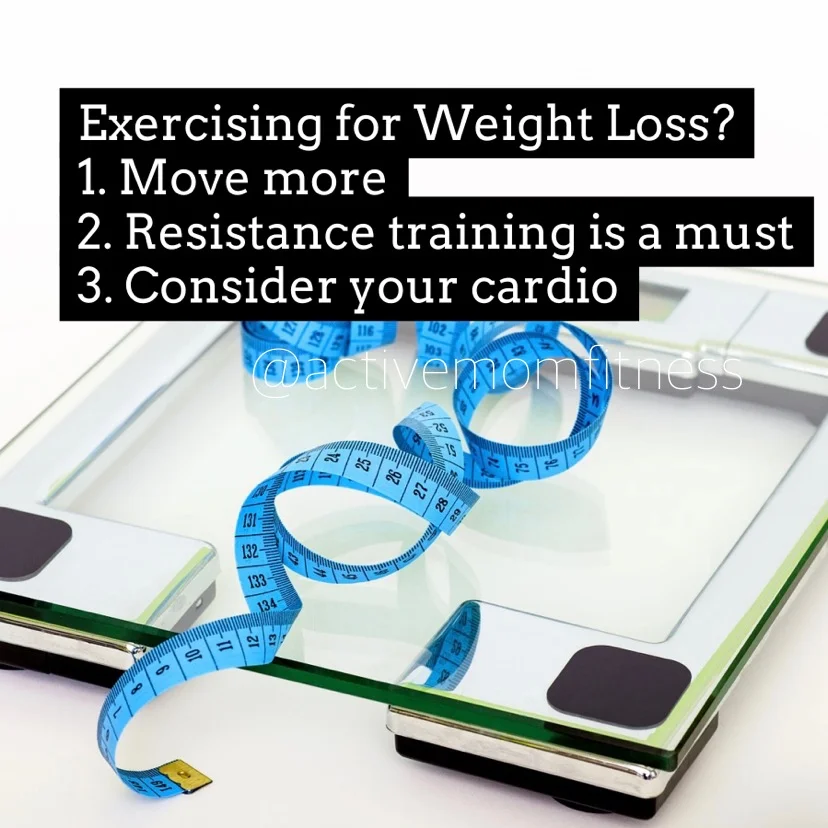
My Number One Recommendation: Move More. Do not make the mistake of thinking only exercise burns calories. It all counts. You pick up any fitness magazine and weight loss is always tied to exercise. But, as a mom you probably have more opportunities during your day just to “move” than to “exercise”, so physical activity deserves just as much attention as your workouts. You want to burn more calories every day? Increase your physical activity and move more! A future post is coming on moms and physical activity, but a good starting point is to think about times that your children (even if its tummy time) are moving and how you can join in for a few minutes here and there. More minutes of movement equals more calories used.
My Number Two and an Essential Consideration: Resistance training (strength training, weight lifting, etc.) is a must! In my opinion, resistance training is more important than cardio when it comes to weight loss. Resistance training is movement, so while performing it you’re burning calories AND while you’re recovering from it, you’re burning calories. More importantly, resistance training ensures that you’re preserving muscle while losing weight (meaning the weight you’re losing is fat). Sure you can drop weight without resistance training, but muscles are what gives you shape and helps your metabolism in the long run, so you want to lose as little lean mass as possible. For health benefits, it is recommended that you perform resistance training on each major muscle group twice per week. For most moms I find this is a good starting point because this baselines isn’t yet being met. Your goals, needs, physique and other parts of your exercise program will determine your resistance training needs, but beginning with two workouts each week is essential.

Third Recommendation: Consider your Cardio. Outside of the health benefits, cardio (or aerobic) exercise is a great way to make sure your body is efficient at using the food you consume for energy. At one point spending hours and hours at the gym on a machine was everyone’s approach to weight loss. Now HIIT (high intensity interval training) is all of the rage. Fitness trends change as research progresses. This doesn’t mean the old way is no longer good and doesn’t make the new way the best way. My point is that there are benefits to all types of cardio depending on your goals, abilities and most importantly what you enjoy. If your end goal is to run Broad street then running should be a part of your weight loss plan. If you’re short on time, HIIT is a great way to burn calories long after the workout is over. If you prefer music and choreography, dance classes might be your best bet. Get your heart rate up and burn calories in a way that’s appropriate for you.
As I mentioned early, physical activity isn’t the only factor in weight loss, but if you’re not “moving” your approach is lacking. I give general advice with caution because when it comes to exercise, it’s safer and more beneficial when it’s customized for you. If you’re a new mom, check out my guide to see if you’re ready to embark on your weight loss journey.
If you’re new to exercise, having trouble getting started, or aren’t progressing any more, let me help you with a customized approach.
Get moving!