
Active Mom Insights
Blog posts by Ashley Reid

Nap or Workout? What's More Beneficial For You?
Do you get enough sleep? Yikes, I know this might be a sensitive subject or silly question for moms with babies. But, it is a question worth asking if it is rephrased to, “do you get enough sleep to workout?” Exercise is a physical stressor on the body. So is sleep deprivation. So if you exercise while sleep deprived, you need to consider the consequences. However we also know that exercise has many benefits, including aiding in sleep and providing energy…so avoiding it all together isn’t always the best solution either.
Do you get enough sleep? Yikes, I know this might be a sensitive subject or silly question for moms with babies. But, it is a question worth asking if it is rephrased to, “Do you get enough sleep to work out?” Exercise is a physical stressor on the body. So is sleep deprivation. So if you exercise while sleep-deprived, you need to consider the consequences. However, we also know that exercise has many benefits, including aiding in sleep and providing energy…so avoiding it all together isn’t always the best solution either.

For many moms there probably won’t be one answer. It will probably vary week to week based on cumulative sleep loss and type of physical activity, knowing some workouts are more intense than others. So although I can’t give you a definitive answer, I can provide you with some factors to consider when you’re debating whether the 30-minute nap vs. 30 minutes of exercise is more beneficial for you.
If you are strength training and not getting adequate sleep after workouts, your results could be compromised. During resistance training your muscles essentially break down and it’s in repairing that you see results like increased strength and definition. Growth Hormone is the hormone responsible for this repair, however, this hormone is produced during sleep. So if you’re not sleeping enough, your muscles may not have sufficient repair time to see the results you’re working for. So in this case it may sound like a nap is more beneficial, but a 30-minute nap may not get you to the stage of sleep you need to produce Growth Hormone. You could choose the workout, but if you do, make sure you can get enough sleep that night to support your efforts or perform a workout that does less damage to your muscles.
If you find that when you are participating in the same type of exercise as usual, but your workouts are seemingly harder, this could mean the lack of sleep is impacting your perceived level of exertion. Research has shown that with insufficient sleep, your workouts may feel more challenging than you’d normally think they are. Most people don’t like to suffer through workouts they believe they should be able to do, so this change in perception might dissuade you from keeping up with your exercise plan. However, studies do show that interval training with intervals of 30 seconds or less may not impact your perception of exertion quite as much as longer intervals.
If you’re exercising with a weight loss goal, lack of sleep can interfere with your progress. You have hormones like Lepitin, ghrelin, and endocannabinoids and their role is to regulate appetite. Without proper sleep, they may cause you to crave carbohydrates. Cortisol is another hormone that is impacted by sleep. With the stress of sleep deprivation, your levels of cortisol may remain high which then affects both weight loss and can disrupt sleep.

If you’re wondering if there are actually any benefits to napping, there are. Studies have shown that napping can improve cognitive function. If your brain feels foggy, or your attention span isn’t great, or your memory seems off, napping could be of benefit to you. The best time to nap is between 1-4 pm and between 20-40 minutes so that you don’t disrupt your bedtime sleep. Additionally, when observing sleep deprived athletes, there is evidence that napping can improve physical performance (the same improvement was not seen in well rested athletes).
Well, I started this post saying that there won’t be one answer, but I’ve definitely given you some things to consider. My best advice would be if your sleep deprivation is chronic, that you should aim for low to moderate-intensity exercise, and just enough to meet the physical activity recommendations for health. If your sleep deprivation is more acute, considering the timing of your workout may be beneficial. Because exercise performance decreases each hour after waking, aiming for physical activity early in the day can lead to a better workout. If there is a possibility for a nap, I’d suggest not planning to work out in the afternoon between 1-4, as that would be prime time for a nap. If you decide to nap before a workout, giving yourself at least 30 minutes of wake time before activity is recommended.
As you navigate your sleep cycle, a flexible exercise plan can feel more manageable. On days you get good rest, maybe a workout later in the day is possible. On days you wake up early, aim for a morning workout. If your sleep deprivation is sporadic, maybe you skip the workout altogether, or aim for shorter intervals rather than the endurance workout you planned.
At Active Mom Fitness, sleep and the ability to recover are always a factor. If you need more guidance navigating a workout program that works while you’re sleep-deprived, schedule a consultation.
Summer is Coming: Tips for Moms to Meet Their Fitness Goals

I’ll start with a disclaimer that I don’t love the idea of people putting pressure on themselves to up their exercise routine in preparation for summer. I firmly believe fitness is a lifestyle and the best way to sustain results is to be consistent year round. However, with that said, I also see nothing wrong with having aesthetic or other goals that make you feel confident this summer. So if you’re someone that is working toward your summer fitness goals, keep reading for a few tips.
Pregnancy Tips:
Summer can be an uncomfortable time to be pregnant. In order to stay active and continuing to make progress in your fitness consider the following 3 tips.

Exercise first thing in the morning: hot summer days can make it harder for you to regulate your body temperature, and quite honestly can just feel draining. Use the month of May to start a morning workout routine. Working out at the coolest point of the day can be safer, more comfortable and help you stay consistent.
Hydrate: not having enough water can raise your body temperature, and dehydration can even lead to uterine contractions. Make sure to replenish fluids after a workout. Use the month of May to get in the habit of increasing your fluids and maybe even treat yourself to a new water bottle.
Invest in workout gear or embrace the belly and sports bra look: If you no longer have moisture wicking clothing that fits, take some time during May to order a few new tops. You’ll want to be able to dissipate the summer heat. If you exercise regularly your sweat point will be lower in order to help with temperature regulation so you’ll want to stay comfortable and have clothing that drys quickly.
Postpartum Tips

If you’re still recovering from birth or building your fitness foundation, then your goals shouldn’t change too much with the season. However, there are a few tips that will help you plan for increased physical activity outside with your little one this summer.
Invest in a new carrier or switch to a stroller: During the cold months it’s possible you were only wearing the baby around the house or for short walks. With the nice summer days, your walks will get longer (as baby gets heavier) and that can cause neck and back pain without a supportive carrier. Take the month of May to make sure you have the right gear. Look for something with thick shoulder straps and a waist belt. Consider using a stroller for long walks until your core is strong and functional again.
Implement a walking progression: Before jumping in to longer walks and more physical activity, use the month of May to do it gradually. Aim to increase your walks 5-10 minutes each time or by gradual distance increments each week. Use interval style training to prepare your body for longer durations.
A little extra attention to specific muscles: During the month of May set aside 10 minutes/day, at least 3 days per week to focus on strengthening your abs, low back and glutes. Also include mobility exercises for your hip flexors and thoracic spine.
Beyond Postpartum Tips
You’ve been exercising consistently, have a strong fitness foundation and just want a little push toward your goal of more defined arms or feeling comfortable in a two piece at the beach. There is nothing wrong with aesthetics being part of your goals and here are some tips to get you that much closer.
Choose a muscle to focus on: Keep with your regular routine, but choose one muscle group to emphasize during the month of May. Include an additional 10 minutes working that muscle each workout, aiming for 3 days per week of targeted training.
Increase your cardio: If you know me, you know I believe strength training is key. However, if your goal is to see the muscles you’ve been working hard for, a little extra cardio during the month of May can give your body what you need to drop your overall body fat percentage if needed (remember, you can’t target train fat away!). Try adding some intervals to a strength workout or moderate intensity cardio on your strength recovery days.
Increase protein and water: If your plan is to add some cardio for more calorie/fat burning as suggested above, make sure you don’t lose the muscle mass you’ve worked so hard for. Aim to get at least 1g protein/kg of body weight to help you sustain muscle. Don’t forget your body needs enough water to function properly so make sure to hydrate!
So whether you’re pregnant, postpartum or further along in your motherhood journey, May through June is a great time to put these tips into action.
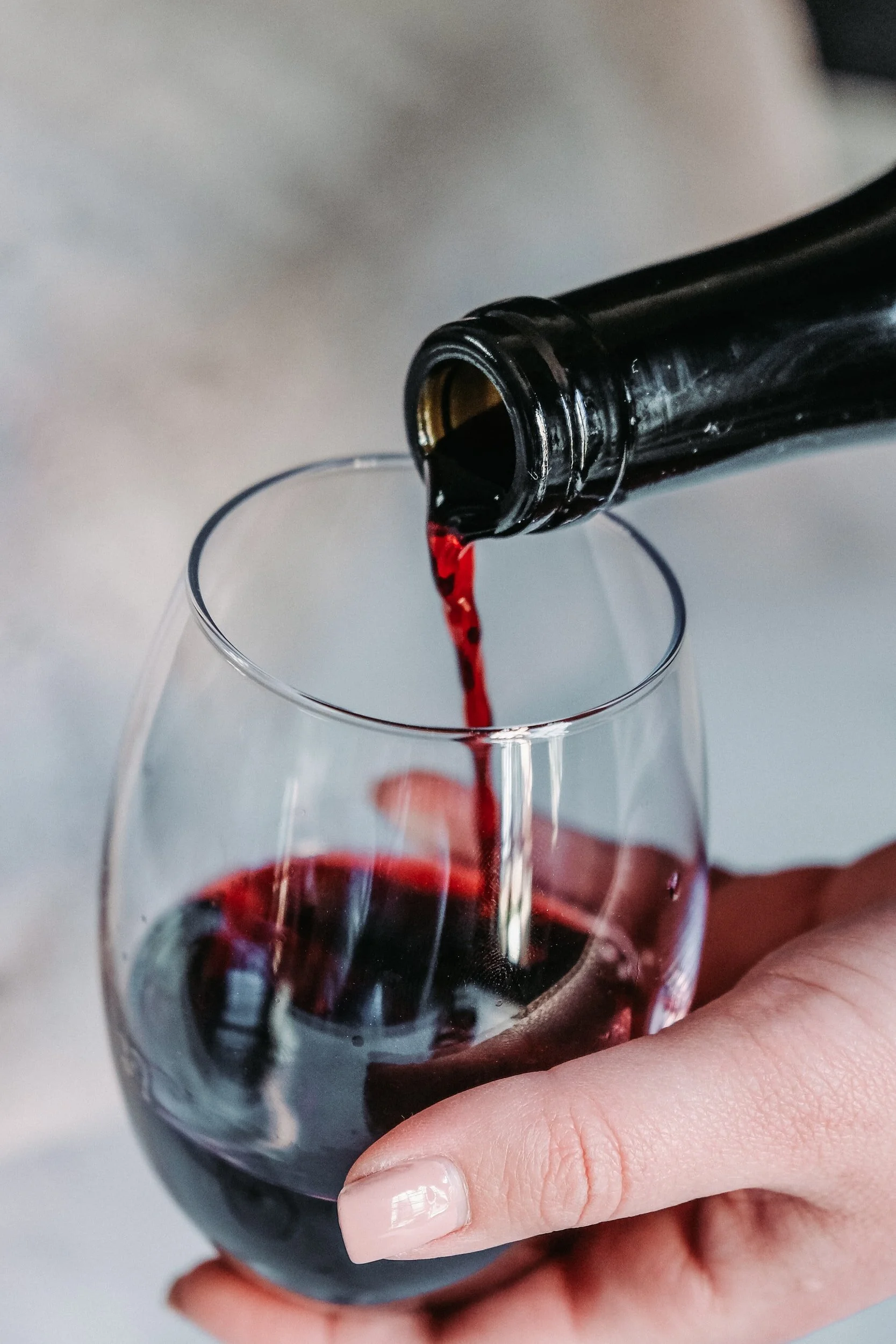
What Happens When You Give Up Weekday Wine? (Four Steps to Healthier Habits)
There’s always been this culture around moms and wine. In 2020 the culture for everyone became quarantine wine. Mom wine and quarantine wine have become part of the culture and an evening ritual for many. However before we discuss your commitment to give up week day wine, I’ll make my first point, which is: your reason for drinking wine probably isn’t as general and broad as, it’s just what moms or people in a pandemic do. So keep that in mind as you continue reading.
There’s always been this culture around moms and wine. In 2020 the culture for everyone became quarantine wine. Mom wine and quarantine wine have become part of the evening ritual for many. However before we discuss your commitment to give up week day wine, I’ll make my first point, which is: your reason for drinking wine probably isn’t as general and broad as, “it’s just what moms or people in a pandemic do”. So keep that in mind as you continue reading.
This article isn’t an opinion piece on drinking culture and really has not much to do with alcohol at all. It’s more about why we have certain habits and what happens when we try to change them. Many moms choose wine as an easy way to relax, have some me time, and escape from all the roles they maintain. Same with quarantine, what became a way to stay entertained for a couple of weeks of quarantine, turned into a routine or way to deal with stress as moved into a year of the pandemic.

Now let’s get back to the catchy headline; no drinking during the week (which is something I’ve heard from many clients as 2021 got underway). Many of you decided to drink less because you want to lose weight, improve sleep, or because you feel like this habit of daily wine has been going on too long. So what happens when you cut back on wine? I’ll give you my personal story.
I decided after the holidays that because I wasn’t moving as much, and things felt a little less festive that there was no need to keep wine in the house. Meaning I’d be eliminating the after dinner wine I would sometimes enjoy. I chose to do this because I wanted to be more conscious about unnecessary calories during more sedentary winter months. It was actually very easy for me not to buy, but what I realized is that I’d then buy occasional sweets instead (which is not something I normally do). I even bought juice, which I NEVER do. Why is this significant? Because I was basically replacing wine with something else and that something else just happened to be high in sugar. My replacement was not going to help me with my goal of watching calories. So although wine was easy for me to give up, I hadn’t addressed why I liked wine after dinner in the first place. I was just giving up one cultural habit for another...trading evening wine for evening sweets.
It was time to dig deeper and you should too. If you want to give something up, you have to figure out why you’re doing it in the first place. I came to the conclusion that wine wasn’t a stress reliever, it wasn’t an escape, it wasn’t an addiction, it wasn’t social. Wine was something I did at the end of the night that signified transition. It was where my day ended and evening began. I was in the habit of doing something to mark the change in time and maybe even give myself permission to drop most of my to-do list. When I gave up wine, I still subconsciously needed a transition and that became a sweet treat.

Once I acknowledged my need and the role the wine was playing, I was able to find a replacement I was happy with to signify that transition. This may sound cliche, but now my habit is to start to brew tea as I’m putting my daughter to bed, so that after I say goodnight I can grab my tea and take 5 minutes transitioning to evening mode. Now my replacement didn’t have to be beverage related. It could have been a workout or a bath or calling a friend or writing in a journal or finishing my last email for the day. I chose tea because it would accomplish my low cal goal and help with sleep (Trader Joe’s Well Rested tea). But the point is, if you're attempting to give up wine during the week, or change any other habit, you should first:
Identify why you’re giving up wine/habit
Identify the reason you’re drinking wine/or that particular habit
Find a direct replacement that is healthy and will accomplish the same thing
Assess whether that replacement has other benefits to solidify your decision
As I said, this article isn’t really about alcohol. If you want to give up hours of binge watching tv, you need to determine why you watch it in the first place and what you’ll do instead….or you’ll find yourself three hours in on the next Netflix trend this weekend.
Happy habit breaking!

Exercise After Baby: What Moms Really Want
On one hand you have the people assuming the ultimate goal is the “snapback”. On the other end of the spectrum are the “all bodies are beautiful” “you’ve just created life” camp.
This post came about after several conversations that I had with my client Simi. During our prenatal strength sessions, we’d often chat about not just her goals during pregnancy, but what they’d be after having her daughter. During one conversation we discussed the varying messages in media and society. On one hand you have the people assuming the ultimate goal is the “snapback”. On the other end of the spectrum was the “all bodies are beautiful” “you’ve just created life” camp. In between sets of TRX rows, we concluded that both perspectives are valid, and that the gray area in between is probably the sweet spot. Weight loss is a valid postpartum fitness goal if that’s important to you, but it would be nice if society understood that your body has been through a lot and “bouncing back” without work (after taking time to recover) is not the case for most.
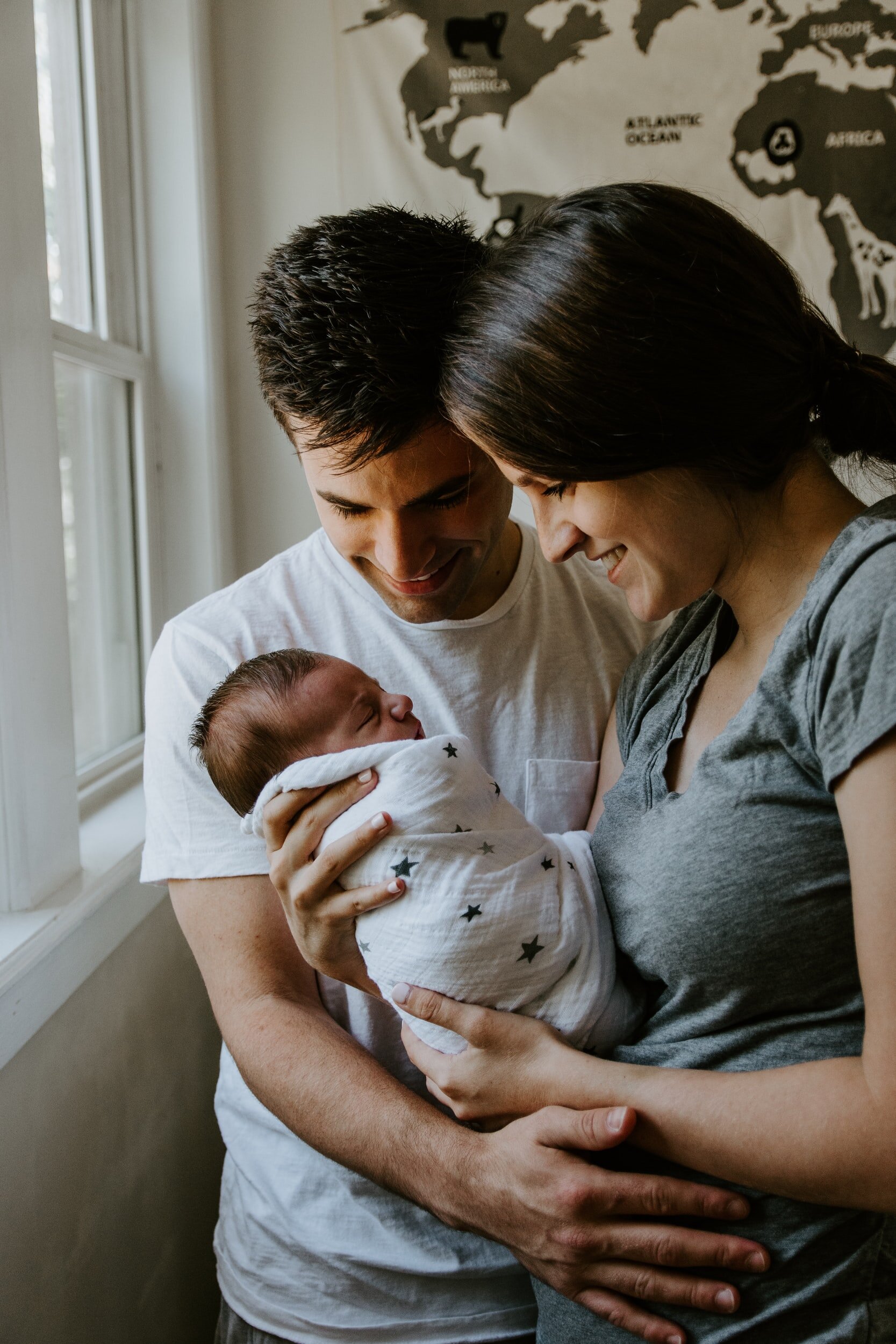
Fast forward to us talking nine months postpartum, and Simi shares, “I remind myself that my being healthy and active (and thus more happy and energetic) is great for me AND my baby! Some weeks I slip (and allow plenty of grace for that!) but overall the scheduling helps keep me in a good rhythm.” This is from someone that was SUPER committed during pregnancy, sometimes getting 5-6 workouts in per week. But her for the stage of motherhood she is in now, motivation for exercise now is to be “happy and energetic”.
Simi’s perspective is not uncommon. With every client I work with, I ask them their top goals. The most common responses:
Feel good about my body
Feel energized
Reduce pain/prevent injury
Build Strength/build core strength
Is that to say weight loss isn’t important? Absolutely not. It just means that for new moms there are other priorities and these are the priorities that society, pop culture, and fitness professionals should recognize. It also means that we can appreciate what our body has done, but still want more for it…again, that gray area.
Simi admits her view did change after having her daughter, "My biggest view change is how quickly I want to get back into my pre-pregnancy shape. While this is absolutely a goal for me, I now realize that achieving it as quickly as I originally wanted would require more sacrifice and time commitment than I am willing to give. Time with my daughter and husband together, time with just my husband, indulging in good food and some wine (even though I maintain a healthy diet overall!), spending time with the few family members we can right now, and mental health days are all things I’m prioritizing in addition to exercise. The balance just means slower results, which is okay for me!"
Let’s keep having this conversation. Let’s make that gray area (of what moms really want) more acceptable and known.
Ready for more tips? Download 5 Tips for a Stronger Core After Pregnancy.

Five Home Workout Tips For Moms: Exercise When You're Home With Kids?!?!
These 5 Tips require a bit of a shift in how we think about exercise, but trust me, you can absolutely maintain and gain fitness while working out at home.
Be creative in what you consider a workout.
Some of you are always juggling family time and fitness time. Some of you have a good routine going where you can escape to the gym. Others may be wondering how you can possibly workout with kids at home. However at the time this post was written, all moms are in this together. We’re home with the kids (social distancing) and need to figure out how to fit in exercise. These 5 Tips require a bit of a shift in how we think about exercise, but trust me, you can absolutely maintain and gain fitness while working out at home.

Be creative in what you consider a workout. Your three year old might not get excited if you ask them to participate in squat jumps, planks or sprints. However, what if you said, “join mommy and jump like a frog (squat jumps), build the strongest bridge (plank) or be a race car driver (sprints)”? Stretch your creative brain and you and your child are in for a good workout.
Short bursts are best. Most children don’t have the capacity for endurance workouts or have a ton of stamina. Take a look around a playground. You’ll see kids running running running and then stop for breaks to climb or swing. Consider this format when planning your workout and you’ll save your sanity. Interval workouts have proven fitness results so plan for 30 seconds to 2 minutes of exercise followed by 1-2 minutes of recovery…also known as tending to whatever your child needs during that time.
Break out the music. Seem obvious? Who doesn’t love a good playlist during a sweat session? Working out at home with kids may mean you switch up your mix. Look for songs that will keep them entertained or even guide in their movement. Think “head, shoulders, knees and toes” or “5 little monkeys jumping on the bed”. Better yet, follow along to this freeze dance workout with your kiddo.
More is more. More short workouts throughout the day are better than one long workout. You’ll have more flexibility if you’re trying to squeeze in three 10-minute sessions versus a 30-minute session. Workouts boost your energy and mood so an added bonus is you’ll stretch the positive vibes throughout the day. Additionally, this mimics a school schedule so if your kiddo is used to dance, free play, recess or gym it's a great way to get them on board with your exercise break. It’s a win-win for you and the fam.
Accept your routine/workout won’t be the same. If most of your workouts take place outside of the home and you temporarily have to find a way for fitness with your children, don’t stress by trying to replicate those workouts. It’s OK to switch up exercise goals and focus. Think of athletes. They have coaches and professionals ensuring they don’t do the same routine year round. They have different seasons. Consider this a change in season for you. Choose a new focus that’s realistic for you. Maybe this means focusing more on yoga, or recovery, or body weight exercise?? Don’t stress. It doesn’t have to be the same. Just keep moving!
See my “working out your workout routine” interview with CBS Philly here. If you’re looking for a little more accountability, try Active Mom Fitness Virtual Live Streams or Private Training. Be sure to subscribe to the Active Mom Fitness Youtube channel for free content.
Exercising for Weight Loss: Are You Taking the Right Approach?
When it comes to weight loss, there are many factors, but simplified, to lose weight you need more energy (calories) going out than energy (calories) coming in. This is where exercise is an asset.
I have one disclaimer before I dive into my recommended approach. I titled this article using the word “exercise”, but what I’m really talking about is the umbrella term Physical Activity. Physical activity is broad and means your body is moving, whether for sport, fun, commuting, exercise, etc. I make this distinction because I consider exercise a structured form of physical activity that comes with the intention of improving physical fitness. Both require energy so we’ll discuss both exercise and physical activity in my top three considerations for weight loss.

When it comes to weight loss, there are many factors, but simplified, to lose weight you need more energy (calories) going out than energy (calories) coming in. This is where exercise is an asset. When you’re moving you’re using energy (burning calories) so exercise in addition to consuming less calories in your diet are two top weight loss strategies. Research shows that moms have the most weight loss success when combining nutrition and exercise. You can check out expert nutrition strategies for weight loss here.
I have one disclaimer before I dive into my recommended approach. I titled this article using the word “exercise”, but what I’m really talking about is the umbrella term Physical Activity. Physical activity is broad and means your body is moving, whether for sport, fun, commuting, exercise, etc. I make this distinction because I consider exercise a structured form of physical activity that comes with the intention of improving physical fitness. Both require energy so we’ll discuss both exercise and physical activity in my top three considerations for weight loss.
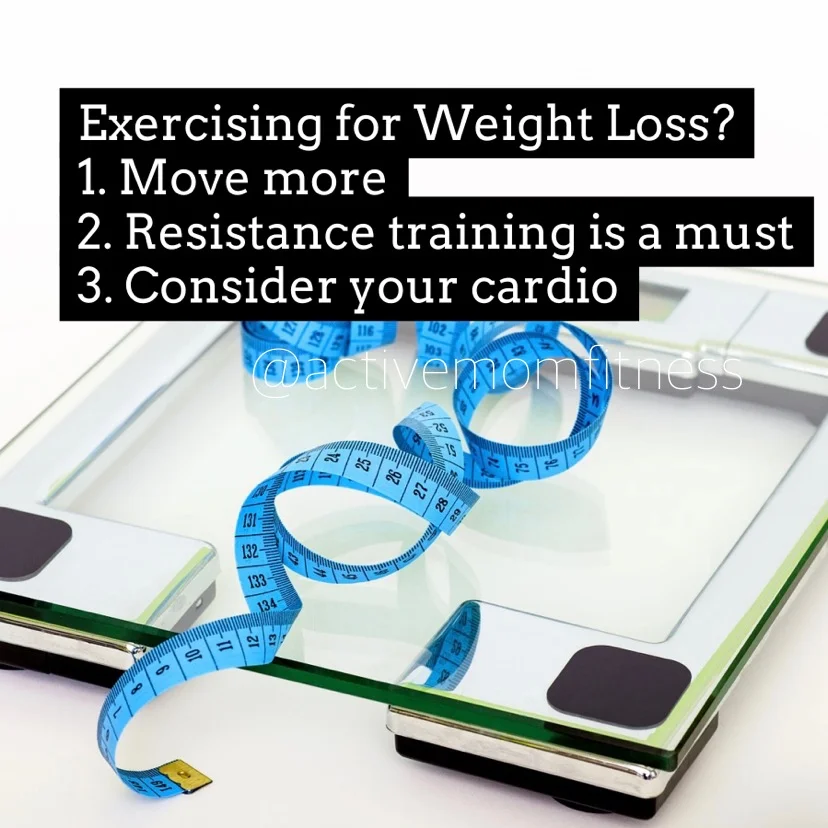
My Number One Recommendation: Move More. Do not make the mistake of thinking only exercise burns calories. It all counts. You pick up any fitness magazine and weight loss is always tied to exercise. But, as a mom you probably have more opportunities during your day just to “move” than to “exercise”, so physical activity deserves just as much attention as your workouts. You want to burn more calories every day? Increase your physical activity and move more! A future post is coming on moms and physical activity, but a good starting point is to think about times that your children (even if its tummy time) are moving and how you can join in for a few minutes here and there. More minutes of movement equals more calories used.
My Number Two and an Essential Consideration: Resistance training (strength training, weight lifting, etc.) is a must! In my opinion, resistance training is more important than cardio when it comes to weight loss. Resistance training is movement, so while performing it you’re burning calories AND while you’re recovering from it, you’re burning calories. More importantly, resistance training ensures that you’re preserving muscle while losing weight (meaning the weight you’re losing is fat). Sure you can drop weight without resistance training, but muscles are what gives you shape and helps your metabolism in the long run, so you want to lose as little lean mass as possible. For health benefits, it is recommended that you perform resistance training on each major muscle group twice per week. For most moms I find this is a good starting point because this baselines isn’t yet being met. Your goals, needs, physique and other parts of your exercise program will determine your resistance training needs, but beginning with two workouts each week is essential.

Third Recommendation: Consider your Cardio. Outside of the health benefits, cardio (or aerobic) exercise is a great way to make sure your body is efficient at using the food you consume for energy. At one point spending hours and hours at the gym on a machine was everyone’s approach to weight loss. Now HIIT (high intensity interval training) is all of the rage. Fitness trends change as research progresses. This doesn’t mean the old way is no longer good and doesn’t make the new way the best way. My point is that there are benefits to all types of cardio depending on your goals, abilities and most importantly what you enjoy. If your end goal is to run Broad street then running should be a part of your weight loss plan. If you’re short on time, HIIT is a great way to burn calories long after the workout is over. If you prefer music and choreography, dance classes might be your best bet. Get your heart rate up and burn calories in a way that’s appropriate for you.
As I mentioned early, physical activity isn’t the only factor in weight loss, but if you’re not “moving” your approach is lacking. I give general advice with caution because when it comes to exercise, it’s safer and more beneficial when it’s customized for you. If you’re a new mom, check out my guide to see if you’re ready to embark on your weight loss journey.
If you’re new to exercise, having trouble getting started, or aren’t progressing any more, let me help you with a customized approach.
Get moving!
New Moms and Weight Loss: Nutrition Advice from the Experts
I often hesitate to discuss weight loss with new moms because it shouldn’t be your first priority. Your recovery and caring for baby are. However, often times hanging on to the excess weight can make you feel more tired, make physical activity less desirable and you may hear a nagging voice every time you get dressed. So although not a priority, weight loss is worth addressing.
There are thousands of articles, books, and methods when it comes to nutrition. I reached out to two fellow mamas and registered dietitians/nutritionists to help you with your approach.
I often hesitate to discuss weight loss with new moms because it shouldn’t be your first priority. Your recovery and caring for baby are. However, often times hanging on to the excess weight can make you feel more tired, make physical activity less desirable, and you may hear a nagging voice every time you get dressed. So although not a priority, weight loss is worth addressing.
It’s important to point out that weight loss requires caloric deficit, meaning more calories out than in. Ideally this is accomplished through a combination of what and how much you’re eating, and how much you’re moving each day. Most dietitians don’t recommend restricting calories while still healing and/or establishing breastfeeding. I agree that trying to lose weight too soon can do more harm than good. So before you embark on weight loss efforts, check out my guide on when you should begin to think about weight loss.
OK….now to the good stuff. There are thousands of articles, books, and methods when it comes to nutrition. I reached out to two fellow mamas and registered dietitians/nutritionists (Beth Auguste of Be Well with Beth and Jennifer of Jennifer Weis Nutrition Consulting) to help you with your approach. Here is a simplified version of their top nutrition strategies for weight loss:

No cleanses or elimination diets. This includes carbs! Jennifer believes that unless there is a medical reason, elimination diets typically don’t work, “this tends to backfire or, at best, works for a while and once normal eating habits resume, the weight returns.” Instead she says, “when making meals, include a healthful carbohydrate, a protein source and some fat to help you feel full longer and slow the rate of digestion.” This combination also helps regulate your blood sugar which plays a role in energy for exercise, mood and cravings. Beth Auguste, registered dietician/nutritionist, is on the same page and goes a step further to suggest, “instead of an elimination diet, focus on adding more fruit and vegetables. The vitamins, minerals and micronutrients will help your liver do its job better [than a cleanse].” She says to aim for 11 servings per day as suggested by the DASH diet.
Hydrate! I love that Beth recommends using water as a “pause button” when you feel snacking getting out of control. “I've seen so many clients achieve fantastic results once they begin to hydrate. Benefits of hydration include, better energy, clear mind, less headaches, better mood, better body temperature control, better appetite control, and clear skin,” explains Beth.
Keep healthy snacks and easy meals on hand. Jennifer knows time is precious for new moms and suggests keeping easy snacks handy so that you’re not reaching for high calorie convenience snacks. Her suggestions include keeping things like greek yogurt and fruit, bowl of ingredients for quesadillas, smoothie bags (in the freezer), or premade nut butter sandwiches in the refrigerator ready to go.

Lastly, I asked them how they felt about “eating in moderation” as it relates to weight loss. I tend to follow the rule that everything can be a part of a healthy diet as long as the majority of the foods you eat are good for you. I don’t like to feel guilty when I eat something not so healthy, so this approach works well for me to maintain a healthy weight without feeling deprived. But my question to the experts was: does moderation work for weight loss? Here’s what they said...
Jennifer is a big fan of moderation as she thinks strict diets are not a long term solution. She shares, “ looking at a food plan through the lens of what you CAN eat rather than what you can’t eat is better overall. Morale during planning and meal times is higher, foods don’t get a good vs bad distinction and, more importantly, all foods can fit into a healthful eating plan anyway. Unless certain foods are avoided due to a medical reason or personal preference, an inclusive eating pattern decreases chances of excessive intake of a “forbidden” food at some point and associated feelings of shame.”
Beth also believes, “To successfully maintain weight loss you must do all of the things that you did while you were losing the weight. So if you ever plan to have alcohol again or be a little bit loose with your diet, you should incorporate these things in to your weight loss plan. I like the 80/20 rule because it allows you to eat "perfectly" 80% of the time, and this will get you results!”
So for those of you ready to incorporate nutrition strategies into your weight loss plan: begin with hydration, 80/20 rule applies to weight loss and maintenance, keep healthy snacks available, and avoid elimination diets. If you need some additional support, reach out to Beth or Jennifer for guidance. I’ll provide you with some exercise strategies in my next post. Stay tuned!
Post Baby Bounce Back: When to Start Thinking About Weight Loss
Snap Back, Bounce Back, Body Back...all terms you hear when it comes to moms that have dropped baby weight rapidly after giving birth (all terms that I think are inappropriate). Celebrities seem to do this rather well. So the question becomes, when is it appropriate to start thinking about weight loss after giving birth? My answer is two fold, but I will try to keep it simple.
Snap Back, Bounce Back, Body Back...all terms you hear when it comes to moms that have dropped baby weight rapidly after giving birth (all terms that I think are inappropriate, but that’s for another post). Celebrities seem to do this rather well. So the question becomes, when is it appropriate to start thinking about weight loss after giving birth? My answer is two fold, but I will try to keep it simple.
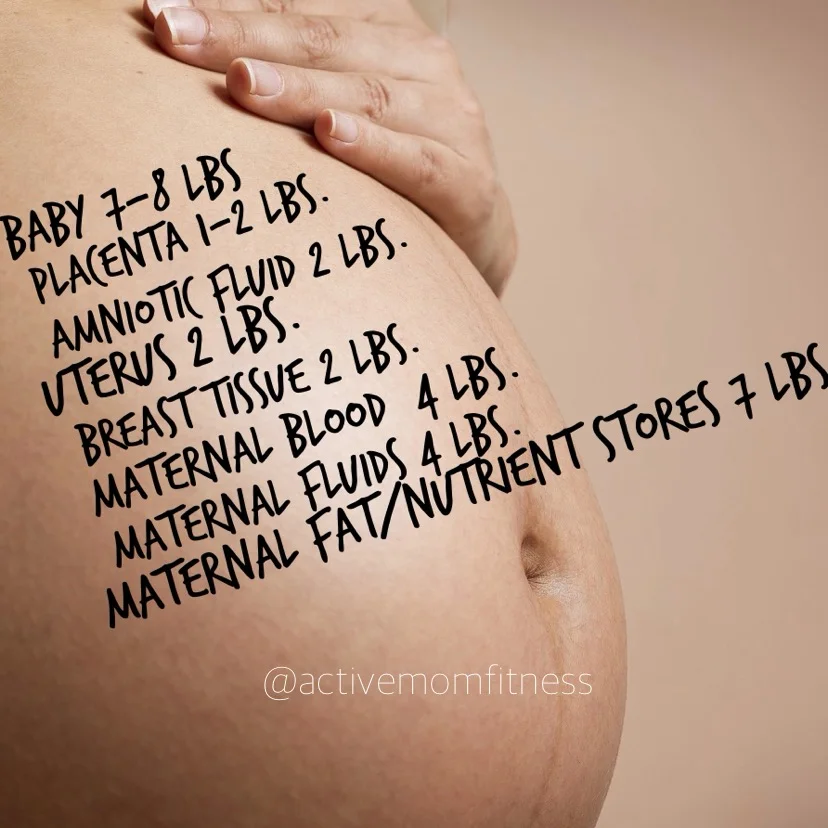
If you begin your pregnancy at a healthy weight, the guidelines state 25-35 pounds of weight gain is recommended. Some women gain more and some less. The goal during pregnancy, as it should be at all times during your life, is to maintain a healthy weight that’s appropriate for you. Weight gain is healthy during pregnancy, but excessive weight gain is not. Excessive weight gain can make it harder for you to lose weight after pregnancy. The point I want to drive home here, is that your first consideration of postpartum weight loss should be while you’re pregnant. Your goal should be to make good food choices, be physically active and consider other lifestyle factors that promote healthy weight gain during pregnancy.
For many of you reading this, you’re beyond pregnancy and probably want to know when to start thinking about weight loss after having baby. You’ll notice that immediately after giving birth your numbers on the scale will drop (losing fluid, weight of baby, etc.). So when should you start thinking about the rest?
I’ll preface it by making it clear that I feel your priority is adjusting to life as a mom and taking care of baby. But, there are many moms that feel the pressure from our “snapback” society or from the expectations you have for yourself to get back into your pre-pregnancy jeans. Some of you may physically feel uncomfortable hanging on to the extra weight. Beth Auguste, RD of Be Well With Beth agrees, “we hear so much about snapping back that it makes sense if you want to prioritize weight loss, but it not what your body needs. Now is the time to remind yourself that your body needs nutrients to heal, especially if you are breastfeeding”. Although it may not a priority, it is on the minds of a lot of moms so discussing weight loss is relevant. Here is my guide to help you determine if you’re ready to start making an effort toward weight loss:

Are you incorporating healthy habits? Maintaining a healthy weight is a lifestyle. Your weight loss efforts will be difficult if you haven’t found a way to incorporate healthy habits into your new life as a mom. Examples include: not skipping meals, drinking enough water, finding time to move, etc.
Are you recovered? It can take your body up to 12 months to recover after having a baby and this should be priority. Consider: whether your c-section scar has healed, how are you feeling emotionally? Is your core getting stronger? Are you finding time to sleep? Registered dietician, Jennifer Weis, shares, “there are other concerns during this time such as healing any birth wounds, ensuring a nutrient dense diet and keeping mom well-fed to be able to handle the stresses of taking care of a new baby while sleep deprived”.
Is exercise a stressor? Weight loss efforts are best when you combine exercise and nutrition. However, structured workouts shouldn’t be a priority if finding time for them causes you stress (stress hormones make it hard to lose weight), or if you’re severely sleep deprived and won’t be able to recover, or if exercise makes you feel physically worse.
So if you’re postpartum and can say your habits are healthy, you’re recovered and structured exercise seems realistic, then yes, it may be appropriate for you to up your weight loss efforts. This timeline will be different for every mom. Weight loss progress will be different for every mom (consider factors such as whether hormones are still affected by breastfeeding, your age, the volume of exercise, nutrition habits, weight loss history, genetics, etc.). If you need some guidance on this process, don't hesitate to reach out to me..
As always, these posts are inspired by moms like you. If you find them interesting, please share on social media.